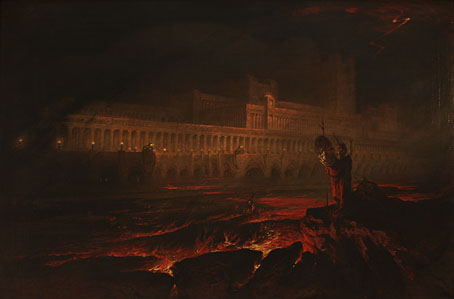
Pendemonium, by John Martin, 1841.
In the following I've taken a closer look at
John Milton's Paradise Lost, Book One lines 700-722:
... Nigh on the plain, in many cells prepared,
That underneath had veins of liquid fire
Sluiced from the lake, a second multitude
With wondrous art founded the massy ore,
Severing each kind, and scummed the bullion-dross.
A third as soon had formed within the ground
A various mould, and from the boiling cells
By strange conveyance filled each hollow nook;
As in an organ, from one blast of wind,
To many a row of pipes the sound-board breathes.
Anon out of the earth a fabric huge
Rose like an exhalation, with the sound
Of dulcet symphonies and voices sweet--
Built like a temple, where pilasters round
Were set, and Doric pillars overlaid
With golden architrave; nor did there want
Cornice or frieze, with bossy sculptures graven;
The roof was fretted gold. Not Babylon
Nor great Alcairo such magnificence
Equalled in all their glories, to enshrine
Belus or Serapis their gods, or seat
Their kings, when Egypt with Assyria strove
In wealth and luxury...
------------------------------------------------------------------
This extract appears immediately after Mammon has directed the fallen angels to rifle the “bowels” of hell so they can access gold for the construction of Pandemonium – their new capital of hell (687-690). From the outset I followed Geoff Page’s advice by reading the piece “first solely for the sound and second for the sense” (58). During the first reading I found the effects of alliteration and assonance created a perfect euphony that provided a wonderful aural accompaniment to the visual detail found in the passage. I could hear the slippery lakes of gold described as “liquid fire sluiced from the lake” (701-702). The emphasis on the double ‘s’ sound in “sluiced” and the alliterated ‘l’ sound on first and second syllables helps us imagine the lapping channels of slick gold rushing through to fuel the creation of Hell’s first palace. The dregs have to be skimmed from the boiling gold and we can hear that too with a similar emphasis on the ubiquitous ‘s’ sound, as Satan’s crew “scummed the bullion dross” (704). The emphasis on ‘s’ evokes the wet and messy work of preparing the materials to fill out the temple.
We know that Milton “played the organ” (Tesky xvi). This piece of biographical information goes some way in helping us understand how he developed the kind of skill required to replicate in verse the sonorities associated with organ music. The imaginative organ simile features the ever present ‘s’ sound again as we are told that the palace rises “with the sound / of dulcet symphonies and voices sweet”. This inventive pneumatic sequence, where the temple rises from the channels of gold, is described by Milton as a process based on inflation by the “sweet” sounding winds of an organ. It’s just one example of Milton’s ability to fuse two seemingly dissimilar elements (air and gold) into an image of a titanic proportion.
Of course, a second reading brings out many of the subtleties in Milton’s writing that may not be apparent in the first reading. Time is needed to unpack ambiguities within the passage, and one such ambiguity can be found in Milton’s description of the palace “built like a temple where pilasters round were set” (713-714). A quick dig in the dictionary tells us that a pilaster is a rectangular shaped column, which makes us wonder why Milton is using “round” as the adjective to the noun. You would assume that with blank verse you would encounter noun/adjective inversions, that is, “round” as the adjective may be placed after the noun, instead of before. But in this instance “round” means “set around”, that is, the columns are set around the palace in a decorative fashion. This example is an instructive case for Page’s argument for a second reading. The example shows that careful examination can bring out the full detail and skill invested in Milton’s verse.
The extract under consideration here shows the range of Milton’s knowledge of music, mining, architecture, Greek and biblical mythology, and the classical canon. Milton's range of expertise is reflected in his impressive vocabulary, featuring technical terms that betray a poet with formidable intelligence. His descriptions of the decorative work around the beams, roof, and columns of the temple, are strikingly ornamental just like the “fretted gold” roofs and “golden architraves” he is envisioning (715-717). These descriptions are effective in evoking images of opulence and grandeur in Satan’s new home – a home that could be seen to rival heaven.
Immediately preceding this passage the narrator says Satan's palace will show “how the greatest monuments of fame… are easily outdone by Spirits reprobate” (695-697). Further, we are told that the angels can create “in an hour” what others can “scarce perform” in an age (697-698). The angels certainly follow through on these claims with the kind of intricate and impressive craftsmanship that would match monuments found in the ancient biblical empire of “Babylon”, or in the land of ancient Egyptian King “Belus” 717-720). Milton’s careful selection of comparable empires, known for their “wealth and luxury” (722) is conveyed effectively through epic simile, the kind of extended comparison we find peppered throughout this sprawling epic.
The quick erection of this palace with such lavish detail is credible because Milton had already drawn Satan’s army as an unrivalled and swift-working “brigade” (675), proceeding in military fashion with "incessant toil" (698). We know that Satan needs a secure base of stability in what is essentially an unstable hell for him and his army. By showing us what this highly efficient crew can achieve, in just one hour, Milton rightly demonstrates the level of organised power expected from a figure that has always been regarded as God’s only truly threatening rival.
Page, Geoff. 80 Great Poems. Sydney: UNSW Press, 2006.
Tesky, Gordan. “The Life of John Milton”. Paradise Lost. Gordan Tesky. New York: Norton, 2005.